
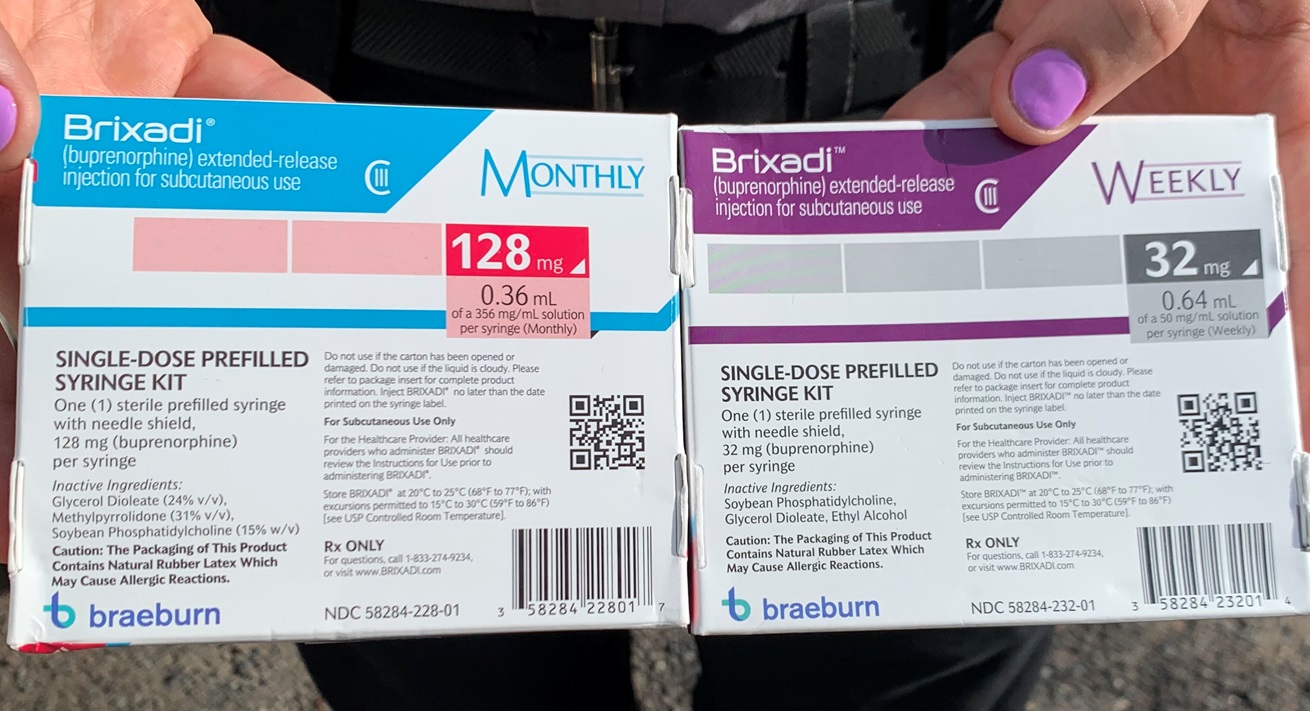
 Cooper EMS is once again pioneering advanced care for patients experiencing an overdose of opioids. Cooper EMS has become the first emergency medical services system in the United States to carry and administer long-acting injectable buprenorphine in ambulances, advancing its groundbreaking approach to treating opioid use disorder (OUD) in the prehospital setting.
Cooper EMS was the first EMS agency in the nation to place sublingual (oral) buprenorphine on its Mobile Intensive Care Unit (MICU) ambulances in 2019, allowing paramedics to initiate medication-assisted treatment immediately after reversing an opioid overdose. Now, the program has evolved further.
In addition to sublingual (SL) buprenorphine (administered orally), Cooper EMS paramedics are now authorized to administer extended-release injectable buprenorphine in the field. The innovation allows patients to receive one week to one month of continuous OUD treatment coverage from a single EMS encounter — providing critical time and flexibility to engage in follow-up care, outpatient treatment, and recovery services.
“Too often, patients survive an overdose but fall through the cracks before they can access treatment,” said Gerard G. Carroll, MD, EMS medical director at Cooper and a national leader in EMS-based addiction medicine. “By allowing paramedics to administer injectable buprenorphine, we’re not just reversing overdoses — we’re initiating sustained recovery at the point of care.”
Buprenorphine is a proven, life-saving medication that reduces opioid cravings, prevents withdrawal, and significantly lowers the risk of repeat overdose. Long-acting injectable formulations help overcome common barriers to treatment adherence, including missed doses, unstable housing, transportation challenges, and delays in accessing outpatient care.
The extended protection period may be especially impactful in communities where access to addiction clinics and outpatient services can be limited. By providing up to one month of medication coverage during the initial EMS encounter, patients have a longer window to identify and secure follow-up care. This reduces the urgency that often leads to relapse when timely appointments are unavailable.
With this expansion, Cooper EMS paramedics can tailor treatment to individual patient needs by initiating stabilization with sublingual buprenorphine or providing extended protection with injectable therapy. This happens during the initial EMS response. Patients are engaged in shared decision-making, preserving autonomy while expanding access to evidence-based care.
“This is about meeting patients where they are,” Carroll added. “EMS is often the only point of contact for individuals with opioid use disorder. Giving paramedics the tools to start durable treatment in the field fundamentally changes what prehospital care can accomplish.”
Cooper EMS’s program reflects years of leadership in community-based addiction intervention and a broader shift toward integrating public health strategies into emergency response. The initiative aligns with state and federal efforts to expand access to medications for opioid use disorder and reduce overdose deaths nationwide.
As the first EMS system in the country to deploy long-acting injectable buprenorphine at the paramedic level, Cooper EMS hopes this model will inform national best practices and inspire other systems to adopt similar life-saving approaches.
About Cooper EMS
Cooper EMS is a nationally recognized emergency medical services program providing basic and advanced life support to the City of Camden, NJ. In 2026, Cooper EMS marked its 10-year anniversary of providing these services — a decade defined by clinical innovation, community partnership, and measurable improvements in emergency response and patient outcomes.
Since assuming responsibility for Camden’s EMS system, Cooper has strengthened response times, enhanced clinical capabilities, expanded community paramedicine initiatives, and integrated public health strategies into emergency care delivery. The program has been recognized for pioneering field-based buprenorphine administration for opioid use disorder and continues to serve as a national model for EMS-led addiction intervention.
Because of its innovation and impact, Cooper EMS has been featured in national media, including special reports on CNN, PBS, and CBS News.
About Cooper University Health Care
Cooper University Health Care is a leading academic health system affiliated with Cooper Medical School of Rowan University. Cooper, headquartered in Camden, New Jersey, has revenues of more than $2.4 billion and an A+ credit rating from both S&P and Fitch Ratings.
Cooper has nearly 14,000 team members, including nearly 1,600 nurses, more than 1,000 employed physicians representing 95 specialties and subspecialties, and more than 700 advanced practice providers.
Cooper operates MD Anderson Cancer Center at Cooper as well as three hospitals – its 663-bed flagship Cooper University Hospital in Camden, its 229-bed Cooper University Hospital Cape Regional in Cape May Court House, and Children’s Regional Hospital in Camden.
Cooper University Hospital in Camden is the only Level 1 trauma center in South Jersey and the busiest in the region. The hospital has been recognized as a top-performing regional hospital by U.S. News & World Report’s Best Hospitals annual survey for six years.
More than 2.4 million patients visit Cooper’s facilities annually. Cooper’s ambulatory network encompasses three outpatient surgery centers, seven urgent care centers, a wound care center, and more than 130 physician, physical therapy, and radiology offices extending from the Delaware River to the New Jersey shore.
Cooper was named one of America’s Best Large Employers for 2026 by Forbes, ranking among the top 200 in the nation. Visit CooperHealth.org to learn more.
####