
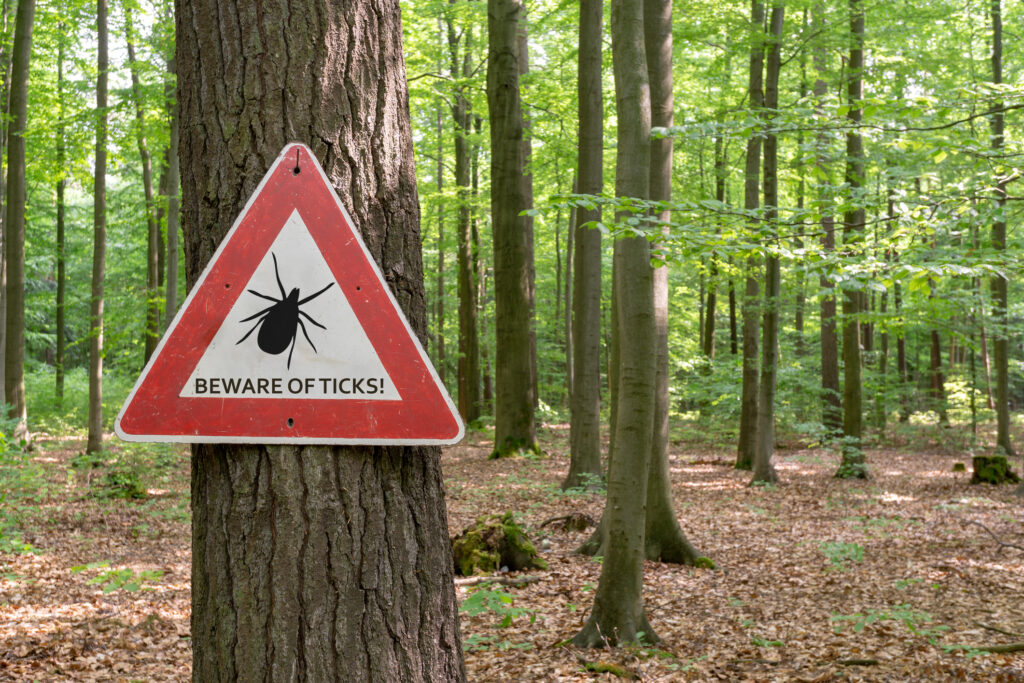
New Jersey has one of the highest rates of Lyme disease and other tick-borne illnesses in the country. Though ticks can be active year-round, they’re especially active during the warmer months. This year, experts are seeing a notable surge.
Para leer en Español, por favor haga clic aquí
Tick activity is off to an early start across the Northeast. According to recent reports, New Jersey has seen its highest year-to-date number of tick-related emergency department visits in five years. The CDC reports that weekly ER visits for tick bites are higher than usual in many parts of the country. That makes prevention especially important as more people head outdoors for yardwork, sports, hiking, beach trips, and time with pets.
Where do ticks live?
The blacklegged tick (also known as the deer tick) is the primary species of tick in New Jersey. They can be found in a variety of habitats, but most commonly inhabit wooded or grassy areas, where they can easily attach themselves to animals or humans. Some specific places where ticks may live include:
- Tall grasses and shrubs
- Wooded areas, especially areas with leaf litter and undergrowth
- Burrows and dens created by small animals such as mice, squirrels, and chipmunks
- Livestock pastures and fields
- Coastal areas in dunes and beach grass
What is Lyme disease?
“Lyme disease is an infectious disease caused by the bacterium Borrelia burgdorferi, which is transmitted to humans through the bite of an infected blacklegged deer tick,” explains Jennifer Jarecki, DO, an emergency medicine physician at Cooper University Health Care and Medical Director of Cooper’s Urgent Care Centers in Audubon, Cherry Hill, and Cinnaminson. “Lyme disease can affect different parts of the body, including the skin and joints. If left untreated, it can lead to more serious symptoms, such as heart palpitations and neurological problems.”
The early symptoms of Lyme disease can vary from person to person, and some people may not experience any symptoms. However, one of the most common early symptoms of Lyme disease is a circular or oval rash that appears at the site of the tick bite within three to 30 days after the bite. This rash is often called a “bull’s-eye” rash because it has a red center surrounded by a clear area and a red outer ring, but it does not always have that appearance.
Other early symptoms of Lyme disease may include:
- Flu-like symptoms, such as fever, chills, fatigue, and muscle aches
- Headache
- Stiff neck
- Swollen lymph nodes
“It’s important to note that not all people with Lyme disease have a rash, and some may have symptoms that are similar to other illnesses,” Dr. Jarecki says. “If you have been bitten by a tick and experience any of these symptoms, seek medical attention right away. Early treatment can effectively cure the infection and prevent more serious complications.”
What should you do if you are bitten by a tick?
If you find a tick on your body, don’t panic. Not all ticks carry disease-causing pathogens, and not all tick bites result in infection.
“Most tick-borne diseases, such as Lyme disease, are not transmitted immediately when a tick lands on you and bites you,” Dr. Jarecki says. “Most of these diseases are transmitted toward the end of a tick’s feeding.”
If a tick has been attached to the skin for less than 24 hours, the risk of transmission of tick-borne illnesses is generally low. But if you find a tick on your body, it’s important to remove it as soon as possible to reduce the risk of contracting a tick-borne illness.
What’s the best way to remove a tick?
Do not use petroleum jelly, nail polish remover, alcohol, or heat from a match or lighter to try to make the tick back out. These methods could actually cause the tick to regurgitate its stomach contents and increase the risk of disease transmission. Instead, use fine-tipped tweezers to grasp the tick as close to the skin’s surface as possible.
- Pull upward with steady, even pressure. Do not twist or jerk the tick, as this can cause the mouthparts to break off and remain in the skin.
- Once you’ve removed the tick, wash the bite area well with soap and water and apply an antiseptic cream.
- Photograph the tick so your health care professional can identify it in the event you develop symptoms, then dispose of it. The CDC recommends wrapping the tick tightly in tape or flushing it down the toilet.
- Monitor the bite area for any signs of a rash or other symptoms of a tickborne illness in the days and weeks after the bite.
“It’s important to know that people don’t develop immunity to Lyme disease,” Dr. Jarecki says. “Even if you’ve had Lyme disease before, you can get it again – so it’s extremely important to take every precaution to avoid exposure.”
How can you prevent tick bites?
Prevention and regular tick checks are important for anyone who spends significant time outside. Looking for and removing ticks can be a cooperative effort to make sure that places that are difficult to see – such as your scalp and back – are well checked.
In addition to performing tick checks immediately after being outdoors, you can take steps to prevent tick bites by wearing long-sleeved tops and long pants and using tick repellents. DEET is the most common active ingredient in tick repellent and is approved for all ages, including children. Products with higher concentrations of DEET may have a longer repellent effect; however, concentrations over 50% offer no added protection (Source: CDC.gov).
You can also join the “Fight the Bite” effort and visit the New Jersey Department of Health’s website to learn about the many tick-borne diseases in our region and report ticks in your area.
What about pets?
For your pets, prevention is equally important. Pets can be difficult to check for ticks, and they can bring ticks home to you if they spend time outdoors. Use a veterinarian-approved flea and tick repellent applied on a regular schedule. Lyme disease vaccines are available for dogs.
The experienced teams at Cooper’s Urgent Care Centers are skilled at identifying and treating tick bites. If you or a family member has been exposed to ticks and has symptoms of a possible tick-borne infection, visit your nearest Cooper Urgent Care Center in Audubon, Cinnaminson, Cherry Hill, Cape May Court House, Hammonton, Marmora, or Wildwood. Each location offers convenient hours, including weekends and holidays.
Las garrapatas están más activas este año: prepárese
Nueva Jersey registra una de las tasas más altas del país de enfermedad de Lyme y otras afecciones transmitidas por garrapatas. Aunque estos parásitos pueden estar activos durante todo el año, su actividad se intensifica especialmente en los meses más cálidos. Este año, los expertos han observado un aumento considerable.
La actividad de las garrapatas ha comenzado temprano en toda la región del Noreste. Según informes recientes, Nueva Jersey ha registrado la cifra más alta de visitas a urgencias relacionadas con garrapatas en lo que va de año de los últimos cinco ejercicios. Los CDC señalan que las visitas semanales a urgencias por picaduras de garrapata superan los niveles habituales en muchas zonas del país. Por ello, la prevención cobra especial importancia a medida que más personas realizan actividades al aire libre, como tareas de jardinería, deportes, senderismo, visitas a la playa y tiempo con sus mascotas.
¿Dónde viven las garrapatas?
La garrapata de patas negras (también conocida como garrapata del ciervo) es la especie de garrapata predominante en Nueva Jersey. Se pueden encontrar en diversos hábitats, pero habitan con mayor frecuencia en zonas boscosas o con hierba, donde pueden adherirse fácilmente a los animales o a las personas que pasan por allí. Algunos lugares específicos donde pueden vivir las garrapatas son:
- Hierba alta y arbustos
- Zonas boscosas, especialmente aquellas con abundante hojarasca y maleza
- Madrigueras y guaridas excavadas por animales pequeños, como ratones, ardillas y ardillas listadas
- Pastizales y campos de ganado
- Zonas costeras, entre dunas y vegetación de playa
¿Qué es la enfermedad de Lyme?
“La enfermedad de Lyme es una enfermedad infecciosa causada por la bacteria Borrelia burgdorferi, que se transmite a los seres humanos a través de la picadura de una garrapata de patas negras (o garrapata del ciervo) infectada,” explica la Jennifer Jarecki, DO, médica de medicina de urgencias de Cooper University Health Care y directora médica de los centros de atención de urgencia de Cooper Urgent Care Centers en Audubon, Cherry Hill, y Cinnaminson. “La enfermedad de Lyme puede afectar a diferentes partes del cuerpo, incluidas la piel y las articulaciones. Si no se trata, puede provocar síntomas más graves, como palpitaciones cardíacas y problemas neurológicos.”
Los síntomas iniciales de la enfermedad de Lyme pueden variar de una persona a otra, y algunas personas pueden no presentar ningún síntoma. Sin embargo, uno de los síntomas iniciales más comunes es una erupción circular u ovalada que aparece en el lugar de la picadura de la garrapata entre 3 y 30 días después de la misma. A menudo se le llama erupción en «ojo de buey» porque presenta un centro rojo rodeado por una zona clara y un anillo exterior rojo, aunque no siempre tiene ese aspecto.
Otros síntomas iniciales de la enfermedad de Lyme pueden incluir:
- Síntomas similares a los de la gripe, como fiebre, escalofríos, fatiga y dolores musculares
- Dolor de cabeza
- Rigidez en el cuello
- Inflamación de los ganglios linfáticos
“Es importante señalar que no todas las personas con enfermedad de Lyme presentan erupción cutánea, y algunas pueden tener síntomas similares a los de otras enfermedades,” afirma la Dra. Jarecki. “Si le ha picado una garrapata y presenta alguno de estos síntomas, busque atención médica de inmediato. Un tratamiento temprano puede curar eficazmente la infección y prevenir complicaciones más graves.”
¿Qué debe hacer si le pica una garrapata?
Si encuentra una garrapata en su cuerpo, no entre en pánico. No todas las garrapatas portan patógenos que causan enfermedades, y no todas las picaduras de garrapata provocan una infección.
“La mayoría de las enfermedades transmitidas por garrapatas, como la enfermedad de Lyme, no se contagian inmediatamente cuando una garrapata se posa sobre usted y le pica,” afirma el Dr. Jarecki. “La mayor parte de estas enfermedades se transmiten hacia el final del proceso de alimentación de la garrapata.”
Si la garrapata ha estado adherida a la piel durante menos de 24 horas, el riesgo de transmisión de enfermedades transmitidas por garrapatas suele ser bajo. Sin embargo, si encuentra una garrapata en su cuerpo, es importante extraerla lo antes posible para reducir el riesgo de contraer una enfermedad transmitida por estos parásitos.
¿Cuál es la mejor manera de extraer una garrapata?
No utilice vaselina, quitaesmalte, alcohol ni el calor de un fósforo o encendedor para intentar que la garrapata se suelte. Estos métodos podrían provocar que la garrapata regurgite el contenido de su estómago y aumentar el riesgo de transmisión de enfermedades. En su lugar, utilice unas pinzas de punta fina para sujetar la garrapata lo más cerca posible de la superficie de la piel.
- Tire hacia arriba aplicando una presión constante y uniforme. No retuerza ni tire bruscamente de la garrapata, ya que esto puede hacer que las piezas bucales se rompan y queden dentro de la piel.
- Una vez extraída la garrapata, lave bien la zona de la picadura con agua y jabón y aplique una crema antiséptica.
- Fotografíe la garrapata para que el profesional de la salud pueda identificarla en caso de que usted presente síntomas, y luego deséchela. Los CDC recomiendan envolver la garrapata firmemente en cinta adhesiva o tirarla por el inodoro.
- Vigile la zona de la picadura para detectar cualquier signo de erupción cutánea u otros síntomas de enfermedades transmitidas por garrapatas durante los días y semanas posteriores a la picadura.
“Es importante saber que las personas no desarrollan inmunidad contra la enfermedad de Lyme,” afirma el Dr. Jarecki. “Aunque ya haya padecido la enfermedad de Lyme anteriormente, puede volver a contraerla; por ello, es fundamental tomar todas las precauciones para evitar la exposición.”
¿Cómo puede prevenir las picaduras de garrapata?
La prevención y la revisión periódica para detectar garrapatas son importantes para cualquier persona que pase bastante tiempo al aire libre. Buscar y retirar las garrapatas puede ser una tarea conjunta para asegurarse de revisar bien las zonas difíciles de ver, como el cuero cabelludo y la espalda.
Además de revisarse para detectar garrapatas inmediatamente después de estar al aire libre, puede tomar medidas para prevenir las picaduras usando prendas de manga larga y pantalones largos, así como repelentes contra garrapatas. El DEET es el ingrediente activo más común en los repelentes y está aprobado para todas las edades, incluidos los niños. Los productos con concentraciones más altas de DEET pueden ofrecer un efecto repelente más duradero; sin embargo, las concentraciones superiores al 50 % no brindan protección adicional (Fuente: CDC.gov).
También puede unirse a la iniciativa “Fight the Bite” (Combata la picadura) y visitar el sitio web del Departamento de Salud de Nueva Jersey para informarse sobre las numerosas enfermedades transmitidas por garrapatas en nuestra región y reportar la presencia de garrapatas en su zona.
¿Qué pasa con las mascotas?
La prevención es igualmente importante para sus mascotas. Puede resultar difícil detectar garrapatas en ellas, y estas pueden llevarlas a casa si pasan tiempo al aire libre. Utilice un repelente de pulgas y garrapatas aprobado por veterinarios y aplíquelo de forma regular. Existen vacunas contra la enfermedad de Lyme para perros.
Los equipos especializados de los centros de atención de urgencia de Cooper tienen experiencia en la identificación y el tratamiento de picaduras de garrapata. Si usted o un familiar ha estado expuesto a garrapatas y presenta síntomas de una posible infección transmitida por ellas, visite el centro de atención de urgencia de Cooper más cercano: en Audubon, Cinnaminson, Cherry Hill, Cape May Court House, Hammonton, Marmora o Wildwood. Todos los centros ofrecen un horario conveniente, que incluye fines de semana y días festivos.